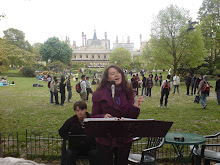
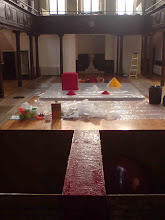
During the exhibitions Fabrica are having a series of short readings from traditional and modern texts. Selected by poet Jackie Wills and painter Jane Fordham, the readings are free, cosy and set in and around the sculptures. Jackie has a blog that gives good insight into her writing, and the AK installations. jackiewillspoetry.blogspot.com/ Narratives in the Frame
During the exhibitions Fabrica are having a series of short readings from traditional and modern texts. Selected by poet Jackie Wills and painter Jane Fordham, the readings are free, cosy and set in and around the sculptures. Jackie has a blog that gives good insight into her writing, and the AK installations. jackiewillspoetry.blogspot.com/ Blood Relations ~ The Movie.
Anish Kapoor
Video sent by tifrap
A film is as faithful to a sculpture as a tee-shirt is to a movie.
Much of Anish Kapoors work has, at its foundation, the premise that sculptures can only be known through the fact of being in their presence, and that everything that is not the sculpture itself, is merely anecdotal interpretation. Visit a sculpture and you know the sculpture's affects on you – but if you read about the same sculpture, you only know someone else’s opinion, which is seldom sculpture.
So I have put this video here, partly to illustrate the rather laboured point above, but also because the text, as a form, deserves to be made accountable to those who might want to study it, deconstruct it, or maybe just couldn’t make the five widdershins that it takes to read it all, without getting dizzy (only happens in glorious 3D reality - yep, its a sculpture).
Jeanne D deux.

But that title, ‘The Dismemberment of Jeanne D’Arc’ appears to be a red herring. The real Jeanne D’Arc was not dismembered, and you can bet that Anish is under no illusions that she was, and he is not one to be flippant with his titles, so there must be some good reason.
Of Jeanne D’Arc we do know that she was burnt on a pyre and her ashes were disposed of in the sea to foil relic hunters. The C-Curve sculpture is located at Chattri, on the spot where funeral pyres burned the bodies of Sikh and Hindu fatalities of world war one, whose ashes were then disposed of at sea. (Muslim fatalities were sent to Woking for burial)
The source of these bodies was the makeshift hospital for Indian war wounded set up in the pavilion complex, the site of the Sky Mirror sculpture.
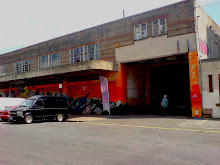
The surviving Indian soldiers migrated in large numbers to the slums that once stood on the present site of the Jeanne D’Arc installation. They went there for sex, scandalising the town and effectively turning the area into a red light district. Here we seem to have another correlation, Jeanne was most likely raped while imprisoned.
Three of the sites for Anish Kapoor’s sculptures during the festival share key roles in the Indian history of Brighton and through their aspects of sex and death offer a passing analogy with the fate of Jeanne D’Arc.
The Sky Mirror in Pavilion Gardens also has a formal relationship with the hole in the Jeanne D’Arc sculpture, in that the sculpture is a disc of sky brought down to earth, or a view into the heavens. The vagina hole of Jeanne D’Arc is also a projected circle, when you stand between her legs, you see a similarly sized disc that is a view into the ground, the depths exposed, fitting for the bodily theme.

There are four venues that house sculpture by Anish Kapoor during the festival, three are perhaps linked, what of the fourth?
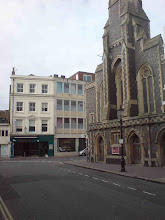
Fabrica is a deconsecrated Methodist church. If there is a connection here with the subject of Jeanne it is not anything to do with the Indian heritage of Brighton. Perhaps it balances the cultural duality of AK himself, but I think it hints at a deeper, less visceral aspect of the Jeanne D’Arc story, one that centres on faith, religious dogma and the nature of questioning.
While Jeanne D’Arc was being tried she was asked whether she was in a state of grace. To answer 'yes' would have been heresy, as only god can know his will. To answer ‘no’ would have proven her guilt. To the amazement of theologians this 19 year old illiterate peasant answered “If I am not, may God put me there; and if I am, may God so keep me.”
What makes this relevant? Anish Kapoor like many artists, is dealing with universal questions and the essence of truth through his work, in fact you could say that all of his work arrives in its vicinity sooner or later. His chosen method of dealing with the ‘big’ subject is to continually contrast absolute simplicity with confusing complexity.
Jeanne illustrates nicely the partisan nature of questioning and how, like sub-atomic particles, question and answer can shift depending on what you wish for. Also like Jeanne, he has a knack for not giving compromising answers to questions where the futility of the answer is already established.
Of course there is a whole load more to it than this ~ and a lot less...
[Remember this is not science]
Narratives in the Frame. Blood & Ink
I was curious to see how Fabrica would pull off hosting an exhibition that potentially epitomises the inaccessible, exclusive face of the art establishment, without damaging its own reputation for placing the arts firmly and intelligently within everyone’s grasp.When I heard that they were throwing Ovid, Murasaki Shikibu and a whole host of other classical sources into the mix, I had to remind myself that if anyone could avoid either bludgeoning its audience with academic authority, or dumbing down in disneyesque proportions, it would be Fabrica.
The respected literary elders have been invoked for a series of associated events called ‘Blood & Ink’ that have been organised by Jane Fordham the painter and Jackie Wills the poet.
Blood & Ink was initially conceived as a development on the working process of Anish Kapoor, in an attempt to understand his ‘fictions’ and how they work, to explore some of his explicit references and to broaden the field. Blood & Ink events are an opportunity to put yourself in the artists place, taking possession of a range of classic myth narratives and exploring them as your own personal source.
Each event is an informal reading with a subliminal trace of performance. They are not all exactly what you would call participatory, but somehow they seem to involve you personally in the interpretation of the narratives. These are far from dry retellings of old stories – each event so far has had a very particular atmosphere, a vitality stemming from the dynamic of the story, reader and listeners combined, they leave you energised and inspired.
Having been to several of these events I get the feeling that they will be responsible for quite a lot of new work from those who have attended.
Last Saturday, watching Ovid being read, coming alive once again after all these centuries, with the power to stop passers-by and quieten small children, to huddle together and be delighted by your own mental imagery, I realised what Fabrica does that is special, and what sets it apart from the majority of galleries.
Fabrica is artist led, it recognises that the arts are fundamentally participatory. The majority of Fabrica’s work is aimed at the artist in you. At Fabrica an exhibition such as AK’s Blood Relations is the focus for a host of process related activities such as ‘Blood & Ink’, that are arguably where the real creativity occurs. Such an approach makes contemporary art extremely personal, you have a stake in it, it is what happens when you engage, right now in the instant, your own individuality with your culture.
When Contemporary Art is approached as a spectator sport, a catalogue of what the great are doing, we all become little more than train-spotters in our own culture, confined to the platform looking for the bookshop.
Strangely enough Ovid is there too.
Blood & Ink details
Music Boxes
To make amends I have spent approximately 3 minutes assembling a thoroughly cheesy short movie that will in no way suffice – to the accompaniment of an antique polyphonic music box. You can be sure that the missing Music Boxes are the antithesis of this, wherever they may be.
Having done this I can fully understand why AK pulled the sculptures, a bad 1970s documentary feel can be the only result. How Jolly. It should really end with a test card.