Showing posts with label Art. Show all posts

Six sculptures and an all over experience

SKY MIRROR

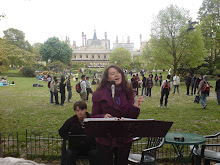
In the wonderful Pavilion Gardens, slightly to one side of the Royal Pavilion, Sky Mirror is one of the Anish Kapoor trade mark works. There are versions in New York and Nottingham. This one’s a bit smaller than either of those, but with all the fabulous architecture and lush nature acting as a framing device this piece is a good place to start a tour around all of the work. Gets you off to a good feel. To linger longer, the café in the gardens, if it’s open (9am-4pm approx, not open in wet weather) is pretty good too, the cakes are worth the effort.

Pavilion Gardens, New Rd, Brighton BN1 1HJ FREE. open 24hrs a day.

THE DISMEMBERMENT OF JEANNE D'ARC

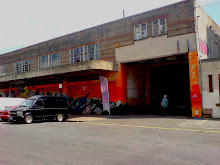
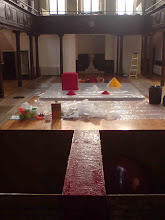
A new sculpture, or rather a series of sculptures made specifically for this great location, the disused municipal fruit and veg wholesale market. Five huge abstracted body parts are laid out, post mortem style. All of them rich, morbid, deep signature red. Anish is quoted as saying this is a new departure for him, but it could be seen as a continuation. The usual techniques and materials are there, pigment, deceptive hole, huge maroon things. It’s just a bit more grizzly than his usual sublime. Feels like Mr Kapoor letting the dogs out.

The Old Market. Circus St, Brighton BN2 9QF behind Brighton University gallery on Grand Parade. FREE. Open 12-8pm

IMAGINED MONOCHROME

Now this really is a whole new ball game. The complete personalised AK experience, an all over sensory Kapoor. No physical manifestation, a reading and then a massage. Imagined and suggested colour, it’s all in your head. Are these the first steps to a new Anish Kapoor methodology or is it a continuation of his involvement with dance and opera? No hard and fast rules or critique. Entrance is every half an hour. Booking beforehand is essential as there are no tickets on the door. Go there with a sandwich, stimulants and your own texts as there are sure to be queues.

The Basement, Kensington Street, Brighton BN1 4AJ Everyday during the festival 10am-6pm. Tickets £12 only from the Festival Box Office 01273-709709

The Basement is in the old Argus print works in the North Laines, amidst all the little shops. Look out for the graffiti on the walls across the street from the Basement.

BLOOD RELATIONS

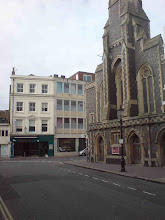
Wander over, back towards the sea, past the Sky Mirror again, to Fabrica in Ship St. In this disused church turned gallery there are two earlier works by Anish Kapoor. The big metal blood bath and raised text that is his collaboration with Salman Rushdie that is the aforementioned Blood Relations (2006). And the rather more delicate work, 1000 names, (1979) which uses colourful pigments. Also in Fabrica is a collection of informative writings about all of Kapoor’s work and a crew of wised up gallery assistants, should you need help or reorientating.

Fabrica, 40 Duke Street, Brighton BN1 1AG 01273-778646 www.fabrica.org.uk

On the corner of Ship St and Duke St, just off North Rd, across the road from Browns café. Opening times 12-8pm everyday during the festival. FREE.

C-CURVE

For this sculpture you’ll need to get a bus or drive, as it’s out of town. The spectacular walk is worth making the effort for in itself, particularly if it’s a bright sunny May day. The C-Curve is a different style of shiny reflective object, placed on the crest of one of the rolling hills above Brighton. For added resonance, Mr Kapoor’s sculpture has been located just above the Chattri, a bleached white shrine created to be a memorial to all the Indian soldiers who fought in the 1st world war. It really is an enchanting place of calm, repose, and picnics.

The Chattri. FREE, 24hr access.

An easy 30 minute signed walk from the Patcham roundabout at the junction of the A23 and A27. Follow the directions to Lewes until the second roundabout. There is a minor road off this roundabout, look for signs for the RSPCA or Braypool Lane. Park just after the turning, the downland path for the Chattri starts here.

Bus 5A from North St or the Old Steine, £1.80 single, £3.40 day return. Get off in Patcham, in the centre of the village walk up Church Hill until Vale Ave, follow the footpath alongside the motorway slip road. When you have crossed the bridge over the flyover to the smaller roundabout, the footpath across the downs to the Chattri is signposted from there. The Chattri website has a small map. www.chattri.com

Sky Mirror

Some images of the Pavilion gardens installation.


Scale & Content

Pavilion Gardens is where the population of Brighton go when our beaches and shopping areas are full of visitors, it is the nearest thing to a real community centre that the people of Brighton possess. Sky Mirror, in effect, had moved into our living room.

Once the Herris fencing was removed, the joint forces of entropy and opinion went to work. In a few short hours the diversity of life in Brighton had reacted in one way or another. Children and clowns saw something to climb over, the intellectuals something to discuss, the Daily Mail readers flexed their best lay critique, and a busker playing a sitar added, I think unknowingly, some serious context.
If there is one thing that Brighton’s living room isn’t short of it is art. Soon enough the celebrity art was the subject of a small, independent, derivative work.
'Empyrean Speculum' mirrored (pun intended), many aspects of the Sky Mirror and its contexts, questioning scale and intent by a simple substitution of values. Like much good art, it amused some, and annoyed others.

Jonathan Gilhooly's performance achieved something that is rare in my experience. It actively raised the issue of the cost of the work, diffusing the ubiquitous, “waste of money” complaints by spreading word that the Anish Kapoor sculptures have all been loaned to the City free.

Micheal O'Connell, security guard for the occasion, has contributed an interesting essay on the event for AN online www.a-n.co.uk

Jeanne D


The Dismemberment of Jeanne D’Arc was created specifically for this years Brighton Festival. It is the most recent new work of Anish Kapoor and prior to its opening last Saturday had not been seen before. That it is such a fresh piece of work also means that it has not had time for the multiple layers of interpretation or ‘fiction’ (to use AK’s phrase) to stick to it. It presents us with an unusual opportunity; to approach an Anish Kapoor work without too much intellectual clutter getting in the way.
The moment I wrote that, I realised that I was beginning the process, if you hate spoilers, best stop reading now.

This work is genuinely site-specific. Not only in that it was made for, and relates to the old municipal fruit and veg market, but also that the place appears to have informed the work. Anish Kapoor, like a lot of artists is often ready to claim site-specificity simply on the basis that something happens to be made to fit a place, like distinguishing a fitted kitchen from self contained units. While all art is necessarily site-specific in a gallery, anywhere else it must either engage with the sites contexts or deliberately ignore the location, not everywhere needs a kitchen. The Dismemeberment of Jeanne D'Arc and its site resonate spatially and contextually, they exchange atmospheres and enhance how each other are read.

As always with Anish Kapoor’s work there are two ways of going about a description, one is to deal with the fact of the work, the other is to engage with the imagined meanings and references that will, no doubt, end up representing it when it is gone.


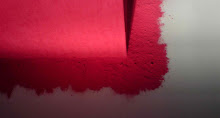
The site is a fairly extensive covered market that has been derelict long enough to develop a vaguely haunted atmosphere, it puts you in mind of the bustle that once occurred here, and although the site has been considerably neatened for this show, there is evidence of its previous occupants, dossers and minor demolition. The Sculpture extends into the space, achieving the sort of monumentality that might accompany the laying of a pipeline. Two long masses, known affectionately by some as twiglets, as high as a hedgerow these block sightlines for half the space. A central excavation and two mounds, comprised of the exact amount of stuff from the hole amassed around columns, complete the intervention. Everything Kapoor in the hall is red, which helps the uninitiated identify the work. The excavated hole, the polystyrene twiglets and the rubble mounds, are all granular, course textured and as evenly sprayed with redness as rather hurried graffiti.

It can take a while to identify the arrangement as representing bits of a woman’s body (that is assuming they do), if you haven’t seen the visuals. A group of year 10 students seemed to cotton on to the fact that they were looking into a huge vagina, with varying degrees of belief in about 10 to 20 minutes. But this is getting into the realms of ‘interpretation’ and that is for the next post.

Jeanne D deux.

All of the elements of the Jeanne D'Arc sculpture are AK’s staples; granular mounds, holes, extrusions, applied pigment, accumulated understanding of the whole etc. These come with their received associations; body references, lingams, female genitalia, self made objects (shit), and a mythic/legendary title with religious relevance.

But that title, ‘The Dismemberment of Jeanne D’Arc’ appears to be a red herring. The real Jeanne D’Arc was not dismembered, and you can bet that Anish is under no illusions that she was, and he is not one to be flippant with his titles, so there must be some good reason.

Of Jeanne D’Arc we do know that she was burnt on a pyre and her ashes were disposed of in the sea to foil relic hunters. The C-Curve sculpture is located at Chattri, on the spot where funeral pyres burned the bodies of Sikh and Hindu fatalities of world war one, whose ashes were then disposed of at sea. (Muslim fatalities were sent to Woking for burial)

The source of these bodies was the makeshift hospital for Indian war wounded set up in the pavilion complex, the site of the Sky Mirror sculpture.

The surviving Indian soldiers migrated in large numbers to the slums that once stood on the present site of the Jeanne D’Arc installation. They went there for sex, scandalising the town and effectively turning the area into a red light district. Here we seem to have another correlation, Jeanne was most likely raped while imprisoned.

Three of the sites for Anish Kapoor’s sculptures during the festival share key roles in the Indian history of Brighton and through their aspects of sex and death offer a passing analogy with the fate of Jeanne D’Arc.


The Sky Mirror in Pavilion Gardens also has a formal relationship with the hole in the Jeanne D’Arc sculpture, in that the sculpture is a disc of sky brought down to earth, or a view into the heavens. The vagina hole of Jeanne D’Arc is also a projected circle, when you stand between her legs, you see a similarly sized disc that is a view into the ground, the depths exposed, fitting for the bodily theme.

There are four venues that house sculpture by Anish Kapoor during the festival, three are perhaps linked, what of the fourth?

Fabrica is a deconsecrated Methodist church. If there is a connection here with the subject of Jeanne it is not anything to do with the Indian heritage of Brighton. Perhaps it balances the cultural duality of AK himself, but I think it hints at a deeper, less visceral aspect of the Jeanne D’Arc story, one that centres on faith, religious dogma and the nature of questioning.

While Jeanne D’Arc was being tried she was asked whether she was in a state of grace. To answer 'yes' would have been heresy, as only god can know his will. To answer ‘no’ would have proven her guilt. To the amazement of theologians this 19 year old illiterate peasant answered “If I am not, may God put me there; and if I am, may God so keep me.”

What makes this relevant? Anish Kapoor like many artists, is dealing with universal questions and the essence of truth through his work, in fact you could say that all of his work arrives in its vicinity sooner or later. His chosen method of dealing with the ‘big’ subject is to continually contrast absolute simplicity with confusing complexity.
Jeanne illustrates nicely the partisan nature of questioning and how, like sub-atomic particles, question and answer can shift depending on what you wish for. Also like Jeanne, he has a knack for not giving compromising answers to questions where the futility of the answer is already established.

Of course there is a whole load more to it than this ~ and a lot less...
[Remember this is not science]

Imagined Monochrome

It is an interesting quandary to consider whether a sculpture is characterised by its physical presence, or its physical effect on your body (and perception). I wonder if AK’s increasing mention of the idea of nothingness, of the primal chaos, has led him to explore no-thing-ness through the omission of the lump of sculpture itself, while retaining the sensory stuff.
Tempting as it is to drag Schrödinger’s cat screaming from Plato’s cave to explain this thought, I’ll resist in favour of a plain description.

As the work is effectively ‘by appointment only’, chances are that if you haven’t booked your ticket, the closest that you will get to the work is going to be a verbal form, however for those who would like to reconstruct the experience with friends, the following may be of some help.

INGREDIENTS:
  • 2 masseuses – Indian head variety (preferably), dressed in white.
  • Several ushers.
  • 1 dark industrial basement (ex-print works is recommended)
    Containing: ~ 2 specially fabricated interconnecting rooms within the space.


    • Room 1 (approx 10’x10’ x8’ high) painted neutral mid grey.

      Contents:

      • 2 doors, each in opposite walls opening outward from the room
      • 2 low plinth-like seats, white with no padding – against doorless walls
      • 2 flourescent lights – one behind each seat.
      • 2 short text instructions (Wait Here, Do as instructed, What to expect, etc) painted on wall above seats in black.


    • Room 2 (approx 10’x10’ x8’ high) painted white.

    • Contents:
      • 2 doors, each in opposite walls, one closed, one leading from previous (grey) room.
      • 1 massage table plus blanket (all white)
      • 1 bright daylight-white luminaire in ceiling immediately above massage table (luminaire approx same dimensions as massage table).


RECIPE:

Upon arrival the subject is:

Received in lobby, checked against booking time and for medical conditions, then ushered downstairs into the basement.

Met in basement by masseuses, confirmed as fit, given instructions then put in grey room to adjust and wait.

Masseuses prepare, open interconnecting door and invite subject to de-shoe and lay upon massage table (fully clothed) face up.

Massage commences, during which a ‘monochrome’ condition is, or isn’t successfully imagined, depending on the subject, and prevailing conditions.

Subject leaves, sculpture leaves with them.

~•~

Clearly all of the concrete elements of this sculpture are common objects that can easily be encountered in a normal situation, however the sensory effects that mark this as an Anish Kapoor are more fugitive.

I have interviewed 3 people about their experiences during this process:
  1. Patient A (Little Hans) Imagined nothing unexpected.

  2. Patient B (Fräulein Elisabeth von R.) Had a visual sensation of colour consisting of two horizontal fields; a softly dappled green above and a rather muddy violet below.

  3. Patient C (Fräulein Lucy R) Experienced a highly animated range of imagined colours almost immediately the massage began, these increased in intensity until the temples were massaged, at which point a fully polychrome dragon made its appearance across the entire visual field.

Anish Kapoor information

At Fabrica there are books and pamphlets about Anish Kapoor, his works and the themes he tackles in that work. These include the Tate's glossy guide to 'Marsyas', his sculpture that filled the Turbine Hall in the Tate Modern a few years ago. It shows and explains how it was constructed, with drawings and photo's of the maquettes, something I hadn't seen before. A major task made to look simple.

I also s
potted in the gallery assistants information pack this photocopy of Descent Into Limbo (1992), a sculpture Anish made for Documenta IX. It was constructed from concrete and stucco but I like the distortion that multiple duplication adds to what was once probably quite a crisp image. Nothing beats photocopying.

Kensington Gardens, Brighton


In Sandpiper Books, copies of this AK book reduced by a fiver for the duration of the Festival. In the second hand shop next door but one, this pink dress, a tenner "because it is modern". 
Both excellent shops to browse, the very essence of Brighton.

From The Argus

I'm noticing how my vision is being affected by an Anish Kapoor filter. I see AK elements everywhere. The current cover of Latest Homes magazine, for instance, (it's in all the racks outside shops around Brighton) has a luxurious lump of red stretched across it proclaiming a new shade of sofa. The Argus, also in festival mode, seems to be having similar visions. Is it possible to create the thought of a colour in a whole city's consciousness? Click on the the heading to read the article.