Showing posts with label Brighton. Show all posts

Six sculptures and an all over experience

SKY MIRROR

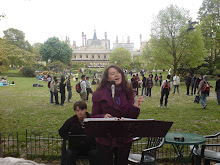
In the wonderful Pavilion Gardens, slightly to one side of the Royal Pavilion, Sky Mirror is one of the Anish Kapoor trade mark works. There are versions in New York and Nottingham. This one’s a bit smaller than either of those, but with all the fabulous architecture and lush nature acting as a framing device this piece is a good place to start a tour around all of the work. Gets you off to a good feel. To linger longer, the café in the gardens, if it’s open (9am-4pm approx, not open in wet weather) is pretty good too, the cakes are worth the effort.

Pavilion Gardens, New Rd, Brighton BN1 1HJ FREE. open 24hrs a day.

THE DISMEMBERMENT OF JEANNE D'ARC

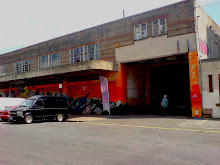
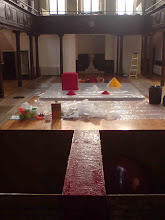
A new sculpture, or rather a series of sculptures made specifically for this great location, the disused municipal fruit and veg wholesale market. Five huge abstracted body parts are laid out, post mortem style. All of them rich, morbid, deep signature red. Anish is quoted as saying this is a new departure for him, but it could be seen as a continuation. The usual techniques and materials are there, pigment, deceptive hole, huge maroon things. It’s just a bit more grizzly than his usual sublime. Feels like Mr Kapoor letting the dogs out.

The Old Market. Circus St, Brighton BN2 9QF behind Brighton University gallery on Grand Parade. FREE. Open 12-8pm

IMAGINED MONOCHROME

Now this really is a whole new ball game. The complete personalised AK experience, an all over sensory Kapoor. No physical manifestation, a reading and then a massage. Imagined and suggested colour, it’s all in your head. Are these the first steps to a new Anish Kapoor methodology or is it a continuation of his involvement with dance and opera? No hard and fast rules or critique. Entrance is every half an hour. Booking beforehand is essential as there are no tickets on the door. Go there with a sandwich, stimulants and your own texts as there are sure to be queues.

The Basement, Kensington Street, Brighton BN1 4AJ Everyday during the festival 10am-6pm. Tickets £12 only from the Festival Box Office 01273-709709

The Basement is in the old Argus print works in the North Laines, amidst all the little shops. Look out for the graffiti on the walls across the street from the Basement.

BLOOD RELATIONS

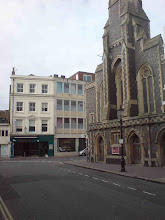
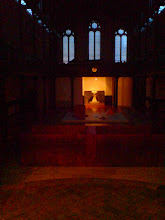
Wander over, back towards the sea, past the Sky Mirror again, to Fabrica in Ship St. In this disused church turned gallery there are two earlier works by Anish Kapoor. The big metal blood bath and raised text that is his collaboration with Salman Rushdie that is the aforementioned Blood Relations (2006). And the rather more delicate work, 1000 names, (1979) which uses colourful pigments. Also in Fabrica is a collection of informative writings about all of Kapoor’s work and a crew of wised up gallery assistants, should you need help or reorientating.

Fabrica, 40 Duke Street, Brighton BN1 1AG 01273-778646 www.fabrica.org.uk

On the corner of Ship St and Duke St, just off North Rd, across the road from Browns café. Opening times 12-8pm everyday during the festival. FREE.

C-CURVE

For this sculpture you’ll need to get a bus or drive, as it’s out of town. The spectacular walk is worth making the effort for in itself, particularly if it’s a bright sunny May day. The C-Curve is a different style of shiny reflective object, placed on the crest of one of the rolling hills above Brighton. For added resonance, Mr Kapoor’s sculpture has been located just above the Chattri, a bleached white shrine created to be a memorial to all the Indian soldiers who fought in the 1st world war. It really is an enchanting place of calm, repose, and picnics.

The Chattri. FREE, 24hr access.

An easy 30 minute signed walk from the Patcham roundabout at the junction of the A23 and A27. Follow the directions to Lewes until the second roundabout. There is a minor road off this roundabout, look for signs for the RSPCA or Braypool Lane. Park just after the turning, the downland path for the Chattri starts here.

Bus 5A from North St or the Old Steine, £1.80 single, £3.40 day return. Get off in Patcham, in the centre of the village walk up Church Hill until Vale Ave, follow the footpath alongside the motorway slip road. When you have crossed the bridge over the flyover to the smaller roundabout, the footpath across the downs to the Chattri is signposted from there. The Chattri website has a small map. www.chattri.com

Narratives in the Frame

During the exhibitions Fabrica are having a series of short readings from traditional and modern texts. Selected by poet Jackie Wills and painter Jane Fordham, the readings are free, cosy and set in and around the sculptures.  Jackie has a blog that gives good insight into her writing, and the AK installations.  jackiewillspoetry.blogspot.com/ 
For more detailed information on the remaining  readings www.fabrica.org.uk

Sky Mirror

Some images of the Pavilion gardens installation.


Scale & Content

Pavilion Gardens is where the population of Brighton go when our beaches and shopping areas are full of visitors, it is the nearest thing to a real community centre that the people of Brighton possess. Sky Mirror, in effect, had moved into our living room.

Once the Herris fencing was removed, the joint forces of entropy and opinion went to work. In a few short hours the diversity of life in Brighton had reacted in one way or another. Children and clowns saw something to climb over, the intellectuals something to discuss, the Daily Mail readers flexed their best lay critique, and a busker playing a sitar added, I think unknowingly, some serious context.
If there is one thing that Brighton’s living room isn’t short of it is art. Soon enough the celebrity art was the subject of a small, independent, derivative work.
'Empyrean Speculum' mirrored (pun intended), many aspects of the Sky Mirror and its contexts, questioning scale and intent by a simple substitution of values. Like much good art, it amused some, and annoyed others.

Jonathan Gilhooly's performance achieved something that is rare in my experience. It actively raised the issue of the cost of the work, diffusing the ubiquitous, “waste of money” complaints by spreading word that the Anish Kapoor sculptures have all been loaned to the City free.

Micheal O'Connell, security guard for the occasion, has contributed an interesting essay on the event for AN online www.a-n.co.uk

Jeanne D


The Dismemberment of Jeanne D’Arc was created specifically for this years Brighton Festival. It is the most recent new work of Anish Kapoor and prior to its opening last Saturday had not been seen before. That it is such a fresh piece of work also means that it has not had time for the multiple layers of interpretation or ‘fiction’ (to use AK’s phrase) to stick to it. It presents us with an unusual opportunity; to approach an Anish Kapoor work without too much intellectual clutter getting in the way.
The moment I wrote that, I realised that I was beginning the process, if you hate spoilers, best stop reading now.

This work is genuinely site-specific. Not only in that it was made for, and relates to the old municipal fruit and veg market, but also that the place appears to have informed the work. Anish Kapoor, like a lot of artists is often ready to claim site-specificity simply on the basis that something happens to be made to fit a place, like distinguishing a fitted kitchen from self contained units. While all art is necessarily site-specific in a gallery, anywhere else it must either engage with the sites contexts or deliberately ignore the location, not everywhere needs a kitchen. The Dismemeberment of Jeanne D'Arc and its site resonate spatially and contextually, they exchange atmospheres and enhance how each other are read.

As always with Anish Kapoor’s work there are two ways of going about a description, one is to deal with the fact of the work, the other is to engage with the imagined meanings and references that will, no doubt, end up representing it when it is gone.


The site is a fairly extensive covered market that has been derelict long enough to develop a vaguely haunted atmosphere, it puts you in mind of the bustle that once occurred here, and although the site has been considerably neatened for this show, there is evidence of its previous occupants, dossers and minor demolition. The Sculpture extends into the space, achieving the sort of monumentality that might accompany the laying of a pipeline. Two long masses, known affectionately by some as twiglets, as high as a hedgerow these block sightlines for half the space. A central excavation and two mounds, comprised of the exact amount of stuff from the hole amassed around columns, complete the intervention. Everything Kapoor in the hall is red, which helps the uninitiated identify the work. The excavated hole, the polystyrene twiglets and the rubble mounds, are all granular, course textured and as evenly sprayed with redness as rather hurried graffiti.

It can take a while to identify the arrangement as representing bits of a woman’s body (that is assuming they do), if you haven’t seen the visuals. A group of year 10 students seemed to cotton on to the fact that they were looking into a huge vagina, with varying degrees of belief in about 10 to 20 minutes. But this is getting into the realms of ‘interpretation’ and that is for the next post.

Narratives in the Frame. Blood & Ink

I was curious to see how Fabrica would pull off hosting an exhibition that potentially epitomises the inaccessible, exclusive face of the art establishment, without damaging its own reputation for placing the arts firmly and intelligently within everyone’s grasp.

When I heard that they were throwing Ovid, Murasaki Shikibu and a whole host of other classical sources into the mix, I had to remind myself that if anyone could avoid either bludgeoning its audience with academic authority, or dumbing down in disneyesque proportions, it would be Fabrica.

The respected literary elders have been invoked for a series of associated events called ‘Blood & Ink’ that have been organised by Jane Fordham the painter and Jackie Wills the poet.

Blood & Ink was initially conceived as a development on the working process of Anish Kapoor, in an attempt to understand his ‘fictions’ and how they work, to explore some of his explicit references and to broaden the field. Blood & Ink events are an opportunity to put yourself in the artists place, taking possession of a range of classic myth narratives and exploring them as your own personal source.

Each event is an informal reading with a subliminal trace of performance. They are not all exactly what you would call participatory, but somehow they seem to involve you personally in the interpretation of the narratives. These are far from dry retellings of old stories – each event so far has had a very particular atmosphere, a vitality stemming from the dynamic of the story, reader and listeners combined, they leave you energised and inspired.

Having been to several of these events I get the feeling that they will be responsible for quite a lot of new work from those who have attended.

Last Saturday, watching Ovid being read, coming alive once again after all these centuries, with the power to stop passers-by and quieten small children, to huddle together and be delighted by your own mental imagery, I realised what Fabrica does that is special, and what sets it apart from the majority of galleries.

Fabrica is artist led, it recognises that the arts are fundamentally participatory. The majority of Fabrica’s work is aimed at the artist in you. At Fabrica an exhibition such as AK’s Blood Relations is the focus for a host of process related activities such as ‘Blood & Ink’, that are arguably where the real creativity occurs. Such an approach makes contemporary art extremely personal, you have a stake in it, it is what happens when you engage, right now in the instant, your own individuality with your culture.

When Contemporary Art is approached as a spectator sport, a catalogue of what the great are doing, we all become little more than train-spotters in our own culture, confined to the platform looking for the bookshop.

Strangely enough Ovid is there too.

Blood & Ink details

Kensington Gardens, Brighton


In Sandpiper Books, copies of this AK book reduced by a fiver for the duration of the Festival. In the second hand shop next door but one, this pink dress, a tenner "because it is modern". 
Both excellent shops to browse, the very essence of Brighton.

From The Argus

I'm noticing how my vision is being affected by an Anish Kapoor filter. I see AK elements everywhere. The current cover of Latest Homes magazine, for instance, (it's in all the racks outside shops around Brighton) has a luxurious lump of red stretched across it proclaiming a new shade of sofa. The Argus, also in festival mode, seems to be having similar visions. Is it possible to create the thought of a colour in a whole city's consciousness? Click on the the heading to read the article.

C – Curve beneath O - moon

Last night the moon was full over Holt hill and the Chattri. A steady stream of people visited the C-Curve sculpture all night long. This is a magical spot on the downs overlooking Deep Bottom. The nearest track, Braypool Lane, in Donkey Bottom, is somewhere that you would rarely come across another person, even in the daylight.

Before C-Curve arrived, the Chattri was one of those secret places unknown even to most Brightonians. If they did know about it, they kept it quiet, because the Chattri is a bit special.

I wish I could have gone to see the full moon over the white marble and the mirrored curve, but I had to spend the night keeping 1000 names and blood relations company.

The security guards that watch the Chattri have told of their surprise at the numbers of people visiting, even at 4AM and the friendliness of those making the pilgrimage. Seems I needn’t worry about my secret spot after all.